Monday, December 26, 2011

New Post on Road Transport :)

Assalamualaikum readers :)

This post gives an overview of the main trends in the environmental impacts of the transport sector as a whole, and road and rail freight transport in particular.

The trends in energy use from transport over the last decades are depicted. Energy consumption in transport almost doubled over this period. The growth in non-OECD countries was even higher: energy use almost tripled over this period. Both for OECD and non-OECD countries, road transport had by far the largest share: about three quarters, and this share is steadily increasing. Projections for energy use until 2050 are shown in Figure 8.2. This graph shows that the energy use of transport is expected to keep on growing at a similar rate as in the last decades, doubling between 2000 and 2040. The growth rates in road freight transport and
rail transport are roughly the same as these general growth rates. Just as happened in the past decades, the energy use of the transport sector is expected to grow much faster in non-OECD countries than in OECD countries. Where non-OECD countries currently account for about 36% of the worldwide transport-related CO2 emissions, their share is expected to equal that of the OECD countries somewhere around 2040. Particularly in Asia and Latin America, energy use of transport is expected to grow strongly.

Figure A

As shown in Figure A, the expected growth is highest in China, where road energy consumption is expected to grow by a factor of five between 2000 and 2030 (He et al., 2005). In China, freight transport has grown much faster than passenger transport (almost twice as fast) and is expected to do so in the future. The energy use of heavy duty trucks in China tripled between 1997 and 2002 (He et al., 2005).

This trend makes clear that reducing energy consumption of transport, and the related greenhouse gas emissions, is becoming more and more a global challenge.

Sunday, December 4, 2011

Did You Know?

Hello Readers :)


The WHO estimated the number of road fatalities at 1.2 million in 1999. Further research showed that this is probably an overestimation (Jacobs and Aeron-Thomas, 2000). They estimated the number of fatalities worldwide at 750 000 to 880 000 in 1999, and the number of people injured by road accidents at 23 to 34 million per year.

It is very difficult to make forecasts for these global figures. In Europe, the number of fatalities is rapidly decreasing (from about 71 000 in 1990 to 41 000 in 2005). However, in other parts of the world, transport growth may well exceed the effect of vehicle and traffic safety improvements. The number of victims from rail transport accidents is much smaller than for road. In the European Union, 105 people were killed in rail accidents in 2004, which was about 0.2% of the number of fatalities in road accidents.

Source: Globalisation, Transport and Environment Book

Thursday, December 1, 2011

Some Components in Globalisation

Assalamualaikum readers :) Today i would like to focus on some components of globalisation in which i can classify it into three main branches:

Economic Globalisation
(1) Freedom of exchange between localities with indeterminate flows of services and symbolic
commodities.
(2) The balance of production activity in a locality determined by its physical and geographical
advantages.
(3) Minimal direct foreign investment.
(4) Flexible responsiveness of organisations to global markets.
(5) Decentralised, instantaneous and 'stateless' financial markets.
(6) Free movement of labour.

Political Globalisation
(1) An absence of state sovereignty and multiple centres of power at global, local and
intermediate levels.
(2) Local issues discussed and situated in relation to a global community.
(3) Powerful international organisations predominant over national organisations.
(4) Fluid and multicentric international relations.
(5) A weakening of value attached to the nation-state and a strengthening of common and
global political values.

Cultural Globalisation
(1) A deterritorialised religious mosaic.
(2) A deterritorialised cosmopolitanism and diversity.
(3) Widespread consumption of simulations and representations.
(4) Global distribution of images and information.
(5) Universal tourism and the 'end of tourism'.

I hope that this information will promote you guys what is globalisation is all about in my point of view. Bye~

Sunday, November 20, 2011

quote of the day

What will we do in a globalised world? All human beings are equal, so they have the same right to have the same lifestyle-the same social security, jobs, and education.

Joschka Fischer

Thursday, November 17, 2011

Air Transport: An Introduction :)

assalamualaikum readers :)

In my previous post, i had wrote about the water transport which is Maritime Shipping. As the continuity, i would now write about another various type of transport that is Air Transportation. Lets find out what is Air Transport is actually about and its relationship with the globalisation.

Air transport is a major industry in its own right and it also provides important inputs into wider economic, political and social processes. The demand for its services, as with most transport, is a derived one that is driven by the needs and desires to attain some other, final objective. Air transport can facilitate, for example, the economic development of a region or of a particular industry such as tourism, but there has to be a latent demand for the goods and services offered by a region or by an industry. Lack of air transport, as with any other input into the economic system, can stymie efficient growth, but equally inappropriateness or excesses in supply are wasteful.

Economies, and the interactions between them, are in a continual state of flux. This dynamism has implications for industries such as air transport. But there are also feedback loops, because developments in air transport can shape the form and the speed at which globalisation and related processes take place. In effect, while the demand for air transport is a derived demand, the institutional context in which air transport services are delivered have knock-on effects on the economic system. These feedback loops may entail direct economic, political and social effects that, for example, accompany enhanced trade and personal mobility, but they may also be indirect, as for example through the impacts of air transport on the environment.

The analysis here focuses on one small sector, international commercial aviation, and on only one direction of causality, the implications of globalisation for this sector. Some related considerations are embraced where particularly important. For example, there is an increasing blurring of international and domestic air transport as airlines form alliances and invest in each other to form global networks. Indeed, the domestic and international air transport market within the European Union (EU) is de facto one market. Also, not all feedback loops are ignored, particularly when changes in air transport facilitate global trends that then, in turn, feed back on the air transport industries; migration of labour is one example of this.

p/s: thanks for reading guys :)

Thursday, November 10, 2011

quote of the day

Assalamualaikum readers :)

We have views on social issues that may seem to some that we are hard-line Tories. However our economics policies and our opposition to the process called globalisation could be considered by some to place us on the far-left of conventional politics.

-Steve Blake-

Monday, November 7, 2011

International Maritime Shipping: The Impact of Globalisation on Activity Levels(PART II)

assalamualaikum readers :)

Lets read the continuity from my previous post. Hope all of you will like it.


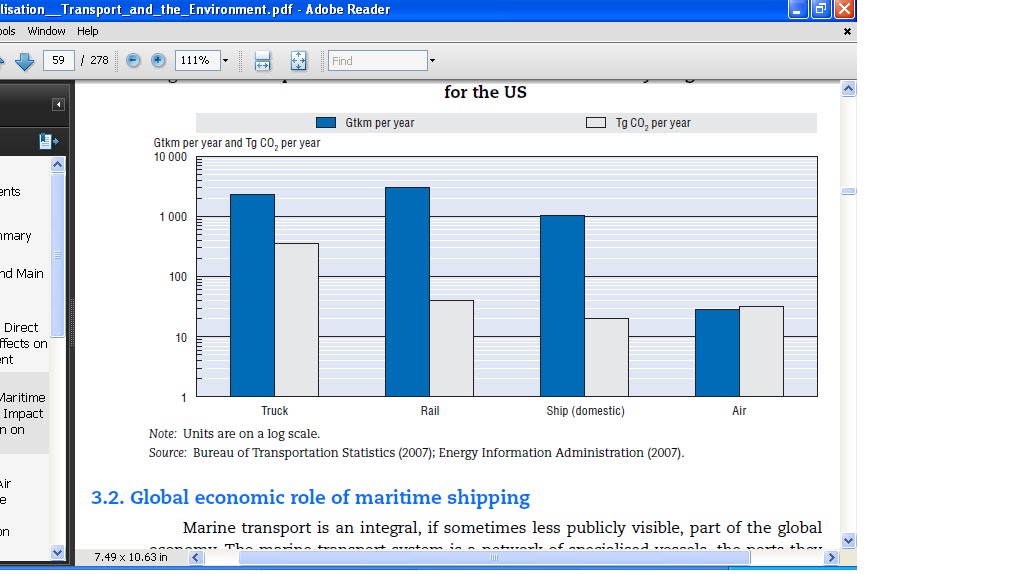
Mode share in freight transport can be measured in several ways, but a common metric is in terms of the work done in cargo tonne-kilometres (tkm). The European Union and the United States have similar mode shares for trucking, about 40% to 45% of total freight transport work (Environmental Protection Agency, 2005a; European Commission et al., 2006b). However, it is important to note that European waterborne freight (inland river and shortsea combined) is second in mode share, moving about 40% to 44% of the cargo tkm in recent years (European Commission et al., 2006a; European Commission et al.,2006b). In the United States, rail freight tkm is slightly greater than road freight. Moreover, these statistics ignore seaborne trade which accounts for about 40 000 giga-tkm (one Gtkm= 109 tkm) of cargo movement among all trading nations from distances outside the domains from which national statistics are reported. Figure 3.2 summarises mode share comparisons in the US for 2005.

Figure 3.2. Comparison of demand and carbon emissions by freight-mode share
for the US


Note: Units are on a log scale.
Source: Bureau of Transportation Statistics (2007); Energy Information Administration (2007).
(sorry if the picture is not clear)